
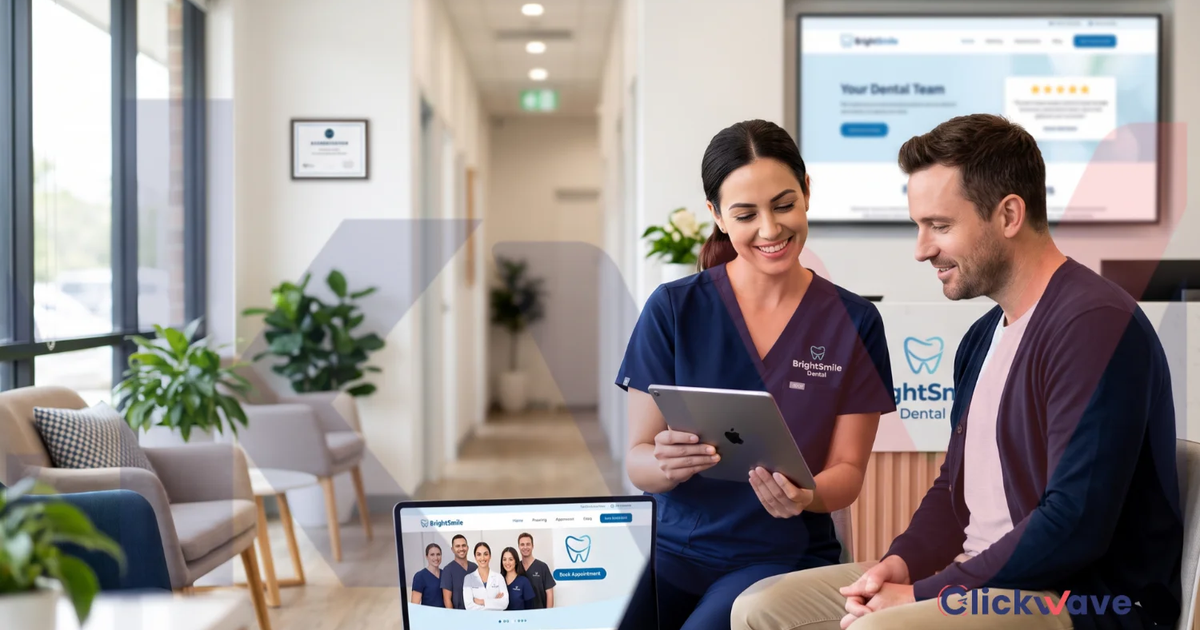
Search "best dental websites" or "top dental websites," and you'll find roundups full of beautiful photography, smooth animations, and minimalist layouts. Most of them look impressive. Fewer of them convert.
The best dentist websites, in the sense that actually matters for a practice owner, aren't the prettiest ones. They're the ones that bring in the most new patient calls. Those two things don't always overlap, and mixing them up gets expensive fast.
This guide breaks down what the genuinely top-performing dental websites have in common, what most dental clinic websites still get wrong, and how you can assess whether your own site is pulling its weight.
How the Best Dental Websites Make a Strong First Impression
A patient who lands on your website from a Google search decides something within about five seconds: does this look like the right practice for me, and can I contact them easily? Sites that answer both questions immediately keep the visitor. Sites that make the visitor scroll, hunt, or click around to find the basics lose them.
The best dental websites put three things above the fold, before anyone has to scroll: what the practice offers and where it's located, a phone number you can tap to call, and a booking option you can't miss. Every piece of content above the fold should serve one of those three jobs. Everything else can wait.
6 Things Patients Look for on Dental Websites
Clear Location & Hours
When someone lands on a dental website, they should not have to dig around to figure out where the practice is or when it is open. Clear location, office hours, phone number, and contact details make it easier for patients to decide whether the practice is convenient for them and take the next step.
Dedicated Service Pages
A single Services page that lists every treatment can't rank for specific service searches. Google sends a patient searching "dental implants" in a specific city to a page built for that exact service, not to a general list. The top dental websites give every core treatment its own page: implants, Invisalign, teeth whitening, emergency care, pediatric dentistry, and cosmetic services. Each page puts the service plus the city right in the H1 and title tags. This one structural choice moves the needle more than almost anything else you can do. ClickWave builds dental websites this way by default.
Real Reviews
The best dental websites don't just link out to Google reviews. They show the review count and average rating right on the homepage. A patient who sees "180 reviews, 4.9 stars" the moment they land trusts you faster than one who has to click away to Google to check. Embedding a Google review widget or showing testimonials with real patient names (with consent, of course) beats any amount of polished copy.
Mobile Friendly
More than 60 per cent of dental searches happen on a phone, and most of those patients want to call or book right away. A site that loads slowly, has buttons too small to tap, or breaks its forms on small screens fails its biggest audience. Top dental websites test mobile first, not last, and treat mobile performance as the actual standard rather than an afterthought.
Readable Schema
The LocalBusiness schema, MedicalBusiness schema, and FAQPage schema tell Google and AI systems exactly what your business is, where it sits, what services it offers, and what questions it answers. Most dental clinic websites skip schema entirely. The best ones implement it correctly on the homepage, every service page, and every FAQ page. Patients never see it, but it carries real weight for local rankings and for AI recommendation systems.
Easy Booking
The best dental websites make it easy for patients to take the next step when they are ready to book. The phone number should be easy to tap on mobile, while an online booking option should be visible on the homepage and key service pages. Contact forms should also be simple to complete and provide confirmation after submission. The fewer steps between a patient deciding to book and actually booking, the better.
What Most Dental Websites Are Still Missing
City-specific language on service pages. Writing "dental implants" with no geographic reference won't rank you locally for anything. Say "dental implants in [city]" and speak directly to patients in that area.
FAQ sections on service pages. Most dental websites describe the service but skip the questions patients actually ask before booking. FAQ sections convert better, and AI systems pull from them when recommending practices.
A doctor’s bio with a real photo. A biography page with a genuine photo, real credentials, and an honest description of the doctor's background and philosophy converts far better than a stock photo and two throwaway sentences.
An accessible, HIPAA-aware contact form. Any form that collects patient information needs to run over HTTPS, avoid storing sensitive data insecurely, and meet applicable privacy requirements. Most dental practices have never actually checked whether their form meets that bar.
How to Assess Your Own Dental Website
Sit down with your site the way a first-time patient would. Search for your practice the way they'd search, from a phone. Read your homepage as if you know nothing about the practice. Try to book an appointment on mobile.
If you catch yourself thinking a patient might get confused, hesitate, or struggle to find the booking option, you've found the problem. The top dental websites eliminate every one of those friction points on purpose, and their owners review and update them whenever patient behaviour or search performance flags something that isn't working.
If your current site isn't bringing in the patient enquiries it should, see what ClickWave includes in dental website design and how we handle conversion alongside search visibility.
Frequently Asked Questions
How often should a dental practice update its website?
Review and update service pages at least once a year so pricing stays accurate, treatments match what the practice currently offers, and FAQ content stays relevant. Update the homepage any time practice information changes: a new doctor, a new location, new services, new photography. Adding fresh content regularly (blog posts, case studies, FAQ entries) tells Google the site is active and maintained.
Is a custom dental website worth it, or does a template work fine?
Template platforms like Wix or Squarespace usually can't handle dedicated service pages, proper schema markup, or the technical SEO foundation that top dental websites need. A custom build or a properly configured WordPress site with dental-specific SEO from day one will consistently outperform a template in local search. The upfront investment pays for itself in new patients over time.
What's the most important page on a dental website?
Individual service pages matter more than the homepage for search traffic and new patient conversion. A patient searching for "dental implants" in a specific city who lands on a dedicated, well-built implants page converts better than one who lands on the homepage and has to navigate from there. Give service pages the same design and content attention as the homepage, and often more.
Should a dental website have a blog?
Build the blog once you've got the service pages, Google Business Profile, and review system in place and performing. Blog content that targets pre-booking questions, treatment comparisons, and cost and insurance topics brings in organic traffic and supports AI search visibility. Blog content built around general dental education topics brings traffic with low conversion value. The real question isn't whether to have a blog; it's whether you've already nailed the higher priority foundations first.
What do top dental websites do differently than they did a few years ago?
The best dental websites treat their site as something they actively maintain, not something they build once and forget. Where older dental sites relied on a single Services page and generic stock photography, the top performers now run individual service pages, real patient reviews on the homepage, mobile-first design, and schema markup that AI systems can read. Practices that haven't touched their website since 2020 or 2021 are competing against sites built for how patients search today.
What trends define the best dental websites right now?
Right now, the top dental websites lean into a few clear trends: AI search visibility through FAQ content and schema markup, mobile-first design over desktop-first design, real patient reviews displayed on-site instead of linked out, and dedicated service pages built around a specific treatment and city rather than one catch-all page. Practices that adopt these trends early tend to outrank practices still running a five-year-old template.