
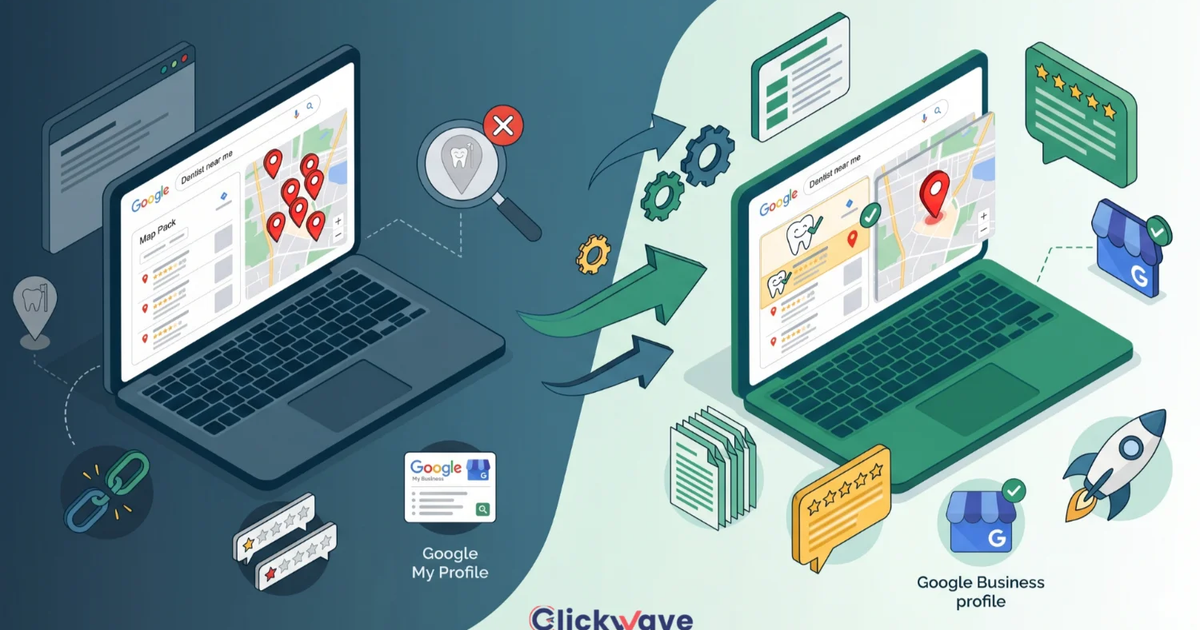
If someone searches for a dentist near them, your practice needs to show up before they call someone else. That is where local SEO comes in. It helps your practice appear in Google Maps, local search results, and other places patients look when they are ready to book.
But ranking locally is about more than adding your city to a few pages. Your Google Business Profile, website, reviews, location signals, and overall online presence all play a role.
This guide breaks down what dentists actually need to know about local SEO in 2025, what is worth focusing on, and what can easily become a waste of time.
Why Local SEO Is the Highest ROI Marketing Channel for Dental Practices
Paid search advertising stops generating traffic the moment your budget runs out. Local SEO doesn't work that way. It builds visibility that compounds and keeps working without a per-click cost attached to it.
A dental practice that ranks in the top three Google Maps positions for "dentist near me" in its city will pull in a predictable stream of new patient inquiries every month, year after year, without paying for each click.
The practices that dominate local search in competitive dental markets didn't get there by accident. They built that visibility through a deliberate local SEO strategy: Google Business Profile optimization, website alignment, citation management, review generation, and local content, all working together.
This guide walks through each of those pieces and what actually works in 2025, plus a few tips most dental marketing agencies won't tell you for free.
Steps to Show Up for “Dentist Near Me” Searches
Google ranks dental practices locally using three signals. Relevance measures how well your profile and website content match what the patient is searching for.
Proximity measures the physical distance between your practice and the person searching. Prominence measures how well known and trusted your practice looks across the web, based on your reviews, citations, inbound links, and content.
You can't control proximity. But you build relevance and prominence deliberately, over time, which is why two dental offices in the same neighbourhood can end up with completely different rankings based purely on how much SEO investment they put in.
Step 1: Google Business Profile Optimization
Your Google Business Profile (you might still know it as Google My Business; Google renamed it a few years back) is the single most influential asset in local dental SEO. It decides whether you show up in the Local Pack at all and how prominently you appear when you do.
Fill out every field. Match your business name, address, and phone number exactly across your website and every directory listing.
Pick the most accurate primary category for your practice, then add every secondary category that applies: cosmetic dentist, pediatric dentist, emergency dental service, oral surgery, whatever fits your actual service mix.
Write a business description that works your primary service keywords and location naturally into the first 250 characters. Upload at least twenty photos covering your exterior, reception area, treatment rooms, and clinical team. List out every service you offer with a real description, not a one-liner. Post updates at least twice a month to keep the freshness signals up.
Step 2: On-Page Local SEO for Your Website
Your website needs to tell Google it belongs in local search results for dental queries in your specific area. That comes down to three things: location-targeted title tags and meta descriptions on every primary page, properly structured local business schema markup that hands Google your NAP data in a machine-readable format, and genuine geographic content that mentions your city, neighbourhood, and surrounding service areas naturally in your copy.
Give each core service its own dedicated page. Include the service name and your city in the title tag, write a real description of the treatment and what patients can expect, and end with a clear call to action. Cramming every treatment into one generic page is a structural disadvantage. Specific, thorough pages consistently outrank thin ones.
One more thing worth adding here: think about how patients actually search now. A growing number of people use voice search, asking their phones something like "who's the best dentist near me that takes walk-ins?" and Google increasingly pulls answers for these queries straight from well-structured, conversational page content. Writing a few FAQ-style sections in plain, natural language (like this one) helps you show up there too.
Step 3: SEO Citations and Directory Listings
A citation is any online mention of your practice's name, address, and phone number. Google uses citations to confirm you're a real, established business at the location you claim. When your practice name or address appears differently across platforms, you send Google conflicting signals, which suppresses your local rankings.
Prioritise these citation sources for dental practices: Google Business Profile, Apple Maps, Bing Places, Yelp, Healthgrades, Zocdoc, WebMD, Vitals, the American Dental Association directory, your state dental association, and your local chamber of commerce.
Keep the NAP information identical everywhere. Audit your citations once a year to catch and fix inconsistencies. It's a standard part of ongoing local SEO maintenance, not a one-time task.
Step 4: Review Generation and Management
Review volume, recency, and how quickly you respond can all influence your local rankings. A practice that earned eighty reviews over the past two years will typically outrank a competitor sitting on fifty reviews from three to five years back, all else equal.
More importantly, patients read reviews before they ever call to book a first appointment. If you have fewer than twenty reviews or sit below a four-star rating, you're losing patients to competitors before they ever make first contact.
The most effective way to generate reviews is a systematic follow-up. Send a text message within 24 hours of the appointment with a direct link to your Google review page.
Cut the number of steps between "I want to leave a review" and actually submitting one down to as close to one step as you can. Practices that automate this through their practice management software, or a tool like Birdeye or Podium, generate reviews consistently instead of relying on staff to remember to ask.
Step 5: Local Link Building
Inbound links from other local websites work as endorsements of your relevance and authority in your area.
The best local links for dental practices tend to come from local news coverage of community events or patient stories, sponsorships of local schools, sports teams, or charities that link back to your site, individual listings in local business directories, and partnerships with other healthcare providers, orthodontists, oral surgeons, or pediatric practices that refer patients back and forth.
You don't need a huge volume of links. A handful of genuine, high-authority local citations and links beats dozens of generic directory submissions when it comes to actual ranking impact.
Step 6: Tracking Your Local SEO Progress
Local SEO without measurement is guesswork. At minimum, track your Google Business Profile Insights every month: how many searches surface your profile, how many website clicks and direction requests you get, and how many calls you generate. Track your organic traffic by source and monitor your keyword rankings for your primary target phrases with a tool like BrightLocal, Semrush, or Google Search Console.
Expect meaningful movement in three to six months for an optimised profile in a mid-competition market and six to twelve months in highly competitive urban markets.
Local SEO compounds, so the practices investing consistently today are building an advantage that new competitors will struggle to close quickly.
Common Local SEO Mistakes Dental Practices Make
- Stuffing keywords into your Google Business Profile business name. This violates Google's terms of service and can get your listing suspended.
- Ignoring negative reviews. It tells prospective patients you don't respond to concerns.
- Letting NAP inconsistencies pile up across directories for years without ever auditing them.
- Using identical service pages across multiple locations instead of customising each one for its specific area.
- Assuming paid Google Ads campaigns improve your organic or Maps rankings. They don't.
Frequently Asked Questions
How long does local SEO take to show results for a dental practice?
You can see initial ranking improvements within six to eight weeks in lower competition markets, if you do a thorough optimisation pass. In competitive markets, expect three to six months before you see real movement in the Local Pack and six to twelve months before you land stable top three rankings for your primary search terms.
Is local SEO worth it compared to Google Ads for a dental practice?
They serve different purposes. Google Ads gets you immediate visibility and works well for new practices or growth periods. Local SEO builds durable organic visibility that doesn't cost you per click. The practices that perform best run both at once: paid search for immediate patients, organic local SEO for long-term cost efficiency.
How important are reviews compared to the other ranking factors?
Reviews are one of the most consistent, measurable local ranking factors you have. In competitive markets, review volume and recency can be the deciding difference between two practices with otherwise similar profiles and websites.
Do I need a separate Google Business Profile for each location?
Yes. Every physical location needs its own verified Google Business Profile. Managing multiple locations takes a more structured approach to NAP consistency and review management, but each location can rank independently in its own area.
Should I hire a local SEO agency for my dental practice or handle it myself?
It depends on your bandwidth. A solo practice with time to spare can handle the basics: claiming and filling out your Google Business Profile, requesting reviews, and fixing citation inconsistencies. Once you're managing multiple locations, competing in a crowded market, or you just don't have hours to spend on it every week, a dedicated dental SEO agency usually pays for itself faster than the DIY route does.
Ready to build dominant local search visibility for your practice? Contact us for a local SEO strategy consultation tailored to your market.