
Invisalign is one of the highest-value elective treatments a general dental practice offers. Patients searching for it are self-qualified, motivated, and typically closer to booking than almost any other dental search query. The problem is that the Invisalign keyword is contested, and most dental practices are not set up to compete for it effectively.
The good news is that competing for Invisalign searches does not require outranking every competitor in your city on the homepage level. It requires a single, well-built page that matches what Invisalign patients are specifically searching for and answers the questions they need answered before they book a consultation.
This guide covers how to build that page, which keywords to target, and how to structure the content to win patients who are already in the buying decision.
Why Invisalign Patients Search Differently
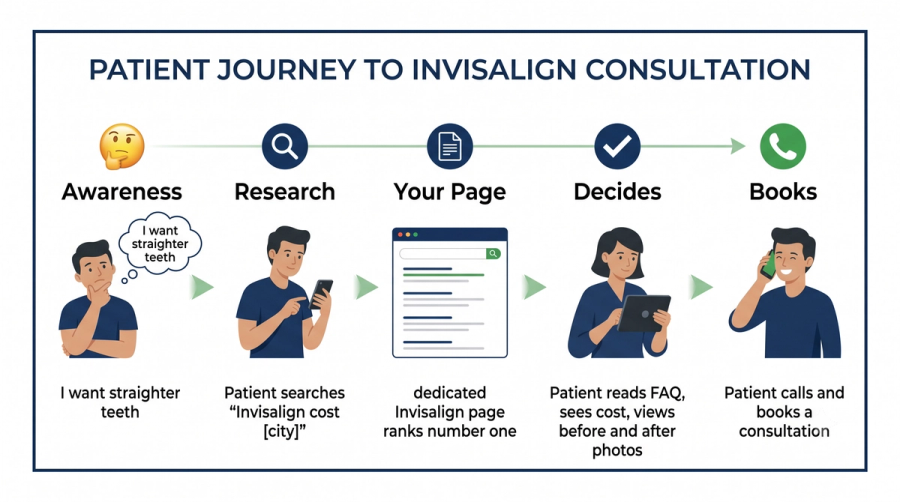
A patient searching for a dentist near me is at an early stage of the decision process. They need a dentist. They have not decided much beyond that. A patient searching for Invisalign cost [city] or Invisalign provider near me has already decided they want Invisalign specifically. They are comparing providers, not deciding whether to get treatment.
This distinction matters for how you build your page. A general dental page designed to capture all dental searches is not the right destination for an Invisalign patient who has already done their research. They need a page that speaks directly to their specific question, shows them what the process looks like at your practice, and gives them a path to booking without requiring them to navigate through your general website.
The Keywords That Drive Invisalign Patients to Your Page
Invisalign SEO is built around a cluster of related searches that represent different stages of the patient journey. The core targets are:
- Invisalign [city] - the primary local search, high intent
- Invisalign cost [city] - cost-comparison search, highest commercial intent
- Invisalign provider near me - proximity search, ready to book
- How much does Invisalign cost - informational, captures early research stage
- Invisalign for adults [city] - specific demographic search
- Invisalign vs braces [city] - comparison search, patient deciding between options
Your dedicated Invisalign page should be built around the primary localised keyword but structured to naturally address all of the above through the content, FAQ sections, and sub-headings. A page that addresses the full cluster will rank for far more searches than one optimised for a single phrase.
How to Structure Your Invisalign Page
URL and Title Tag
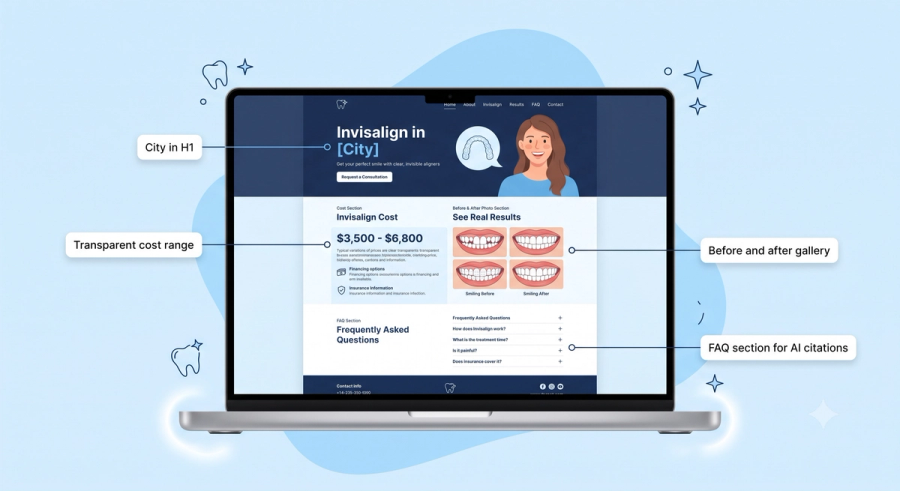
Use a URL that includes the treatment and your city. Something like /invisalign-grand-rapids or /services/invisalign-ann-arbor. Your title tag should follow: Invisalign in [City], MI | [Practice Name]. This is the most direct match to how patients search and how Google reads page relevance.
Opening Section
Lead with a clear statement of what you offer, where you are located, and who you serve. Avoid opening with a history of Invisalign or a general explanation of what aligners are. Patients who have searched for Invisalign in your city already know what Invisalign is. They want to know if your practice is the right place to get it.
Cost Section
Include a dedicated section on cost. This is the highest-searched Invisalign query and practices that avoid it lose both ranking opportunity and patient trust. You do not need to publish a fixed price. A transparent explanation of what affects the cost, such as the complexity of alignment needed, the number of trays required, and whether insurance covers any portion, is more useful to a patient than a vague range.
FAQ Section
Build a FAQ section that addresses the specific questions Invisalign patients ask before booking. Good examples include: Am I a candidate for Invisalign? How long does Invisalign treatment take? Does Invisalign hurt? Can I eat normally with Invisalign? How often do I need to come in for appointments?
These questions serve two purposes. They address real patient concerns and reduce friction to booking. They also give Google's AI Overviews direct Q and A content to extract and cite when patients ask about Invisalign in your area.
Before and After Content
Before and after photos are among the most converting elements on any cosmetic dental page. Patients evaluating Invisalign want to see real outcomes from real patients at your practice. A gallery of documented cases with patient consent, showing the type of alignment corrections your practice routinely handles, builds credibility that no copy can replicate.
If you do not yet have before and after cases to display, describe the types of cases you treat in specific terms. Instead of we treat a wide range of alignment issues, write something like we commonly treat overcrowding, spacing gaps, overbites, and crossbites at this practice. Specificity signals experience.
Want to rank for Invisalign searches in your city?
Get a free dental SEO audit and see your current position
Frequently Asked Questions
Should I build an Invisalign page even if I am not a certified Invisalign provider?
If you are not currently a certified provider, focus on clear aligner treatment more broadly. There are several aligner systems available. A page targeting clear aligners in [city] or teeth aligners [city] can rank and convert while you work toward or decide on specific certifications.
How is ranking for Invisalign different from ranking for general dentistry keywords?
Invisalign searches are more specific and higher intent. The patient has already decided on a treatment. Your page does not need to sell them on the concept. It needs to sell them on your practice as the right place to get it. Structure your content around trust signals, credentials, outcomes, and the patient experience rather than a general explanation of what Invisalign is.
Can I rank for Invisalign against corporate dental chains?
Yes. Corporate chains often have weaker local signals despite their domain authority. A dedicated Invisalign page on a well-optimised local dental website with strong GBP signals, recent reviews mentioning Invisalign, and some local backlinks will outrank a generic chain page in local searches more often than you might expect.