

How to Get More Google Reviews for Your Dental Practice Without Violating Google's Rules
Reviews are the most visible trust signal a dental practice has. They are also one of the clearest ranking factors in Google's Map Pack algorithm. A practice generating five to ten new reviews per month will consistently outperform one with a larger but older and static review total, regardless of how well the rest of the SEO is set up.
The practices that generate reviews consistently are not lucky. They have a system. The ones that struggle are waiting for patients to voluntarily leave feedback, which happens at a fraction of the rate of a structured ask.
This guide covers what that system looks like, what Google's rules actually prohibit, and the exact process for building review velocity without putting your profile at risk.
Why Review Recency Matters More Than Total Count
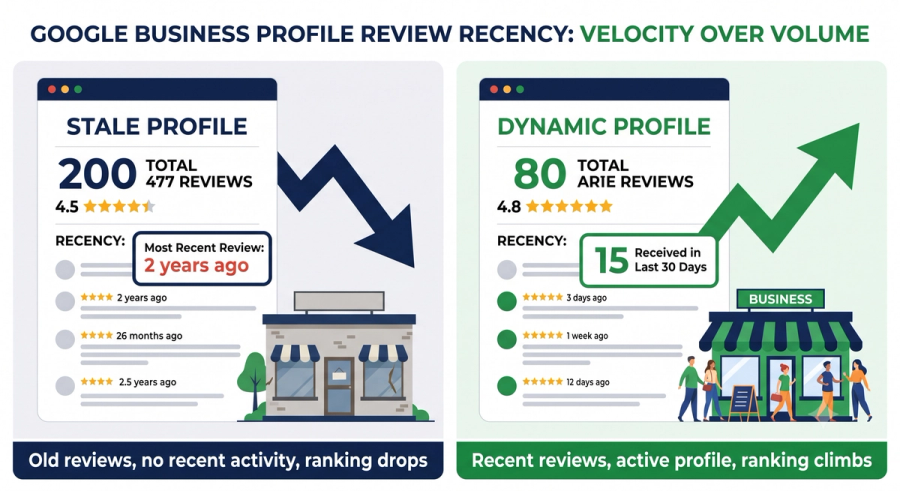
Google weighs recent reviews more heavily than older ones when calculating Map Pack rankings. A practice that collected 200 reviews between 2018 and 2022 and has received nothing since will frequently rank below a competitor with 60 reviews, provided those 60 reviews arrived in the past twelve months.
The logic is straightforward. Recent reviews signal that the practice is actively seeing patients and earning genuine feedback. An old review stockpile tells Google the practice is established but gives no information about whether it is still operating, still good, or still relevant. Recency is the quality Google is trying to measure.
This means a practice cannot rely on a past review push. Review acquisition has to be a consistent, ongoing part of operations. Fifteen to twenty new reviews per month is a realistic and achievable target for most active practices.
What Google Actually Prohibits
Before building a review system, it helps to know exactly what Google's guidelines prohibit so you can avoid the mistakes that get profiles penalised.
- Incentivising reviews: offering discounts, gifts, or any other reward in exchange for a review is a direct violation of Google's guidelines
- Review gating: asking patients how satisfied they were before deciding whether to send them to the review form filters out negative reviews, which Google considers manipulation
- Posting reviews on behalf of patients: logging into a patient's account or any account to post a review for them is a policy violation
- Buying reviews: purchasing reviews from third-party providers puts your profile at risk of suspension
What Google does permit and actively expects is asking patients for honest feedback and making it easy for them to leave a review if they choose to. The goal is to remove friction from a process patients would do voluntarily if it were easy enough.
The Review System That Works
Step One: Timing the Ask
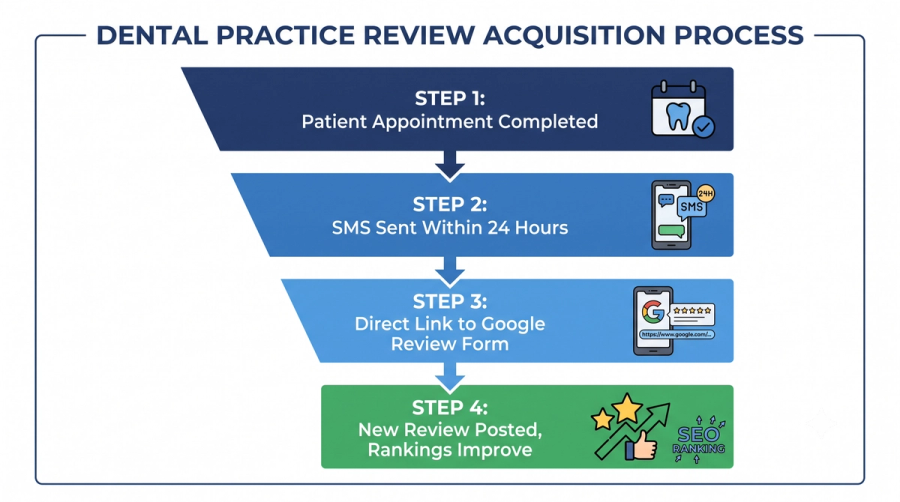
The best moment to request a review is within 24 hours of a positive appointment, while the experience is still fresh. Waiting a week or more drops completion rates significantly. Most practice management platforms support automated post-appointment messaging. If yours does, configure it to send a review request the same day the appointment is marked complete.
Step Two: The Message Format
The message should be short, personal in tone, and contain a direct link to the Google review form. One extra click between a patient's intention and the review form costs completion rates. The link format for Google reviews is simply your Google Maps place URL with the review prompt appended. Your front desk or a tool like Birdeye or Podium can generate and shorten this link for you.
A message that works: Hi [first name], thank you for coming in today. If you have a moment, we would really appreciate it if you could share your experience on Google. It helps other patients in [city] find us. [direct link]
Step Three: Responding to Every Review
Response rate is a signal Google monitors as an indicator of practice engagement. Responding to positive reviews with genuine, specific appreciation and to negative reviews with professionalism and a path to resolution is both a ranking signal and a conversion signal for new patients reading your profile.
Practices that respond to every review within 48 hours consistently outperform those that do not in Map Pack rankings. This is one of the simplest ongoing maintenance tasks in local SEO for dentists and one of the most consistently overlooked.
Step Four: Encouraging Specific Reviews
AI systems and Google increasingly give more weight to reviews that mention specific treatments and locations. A review that says great dentist, highly recommend carries less ranking signal than one that says Dr Smith's dental implant consultation in Grand Rapids was thorough and the pricing was completely transparent. You cannot write the review for the patient, but you can prompt specificity.
When asking for a review, add one sentence: if you are happy to mention what brought you in and what you appreciated most, it helps other patients in [city] know what to expect. That is all it takes to shift the quality of the reviews you receive.
Not sure how your review velocity compares to competitors in your area?
Get a free audit and see the full picture
Frequently Asked Questions
How many reviews does a dental practice need to rank in the Map Pack?
There is no fixed number because it depends on your market. In smaller cities, twenty to thirty recent reviews may be enough. In competitive urban markets, fifty or more is a more realistic baseline. What matters more than the total is the recency. Consistent monthly acquisition always outperforms a one-time push.
Can negative reviews hurt my Map Pack ranking?
Individual negative reviews do not directly suppress rankings the way Google Business Profile gaps or NAP inconsistencies do. However, a low average rating below four stars will hurt conversion rates significantly. Patients choose between practices and a 3.8 average versus a 4.8 average is a decision for most patients before they read a single review.
Does responding to reviews affect my ranking?
Yes. Response rate is a documented signal in Google's local ranking system. Google interprets consistent responses as evidence of an active, engaged practice, which is one of the prominence signals that feeds into Map Pack position.
What is the fastest way to get more reviews right now?
A direct ask during checkout, followed by an SMS within two hours containing a single-tap link to the review form. No friction, no extra steps. If your team asks every patient who had a positive experience today and follows up by text, you will see new reviews within 24 hours.