

Growing a dental practice to two, three, or more locations is a significant achievement. It also creates a set of SEO challenges that a single-location strategy is not equipped to handle. Many multi-location practices try to scale their existing approach and wonder why each additional location produces diminishing returns in search visibility.
The reason is that multi-location dental SEO is structurally different from single-location SEO. Each office is competing in its own geographic market, needs its own Google Business Profile, and requires its own local authority signals. The practices that rank well across all their locations treat each one as its own SEO entity while sharing the brand authority of the group.
This guide covers what changes when you have more than one location, the most common multi-location SEO mistakes, and how to build a strategy that works across your entire practice group.
Each Location Needs Its Own GBP
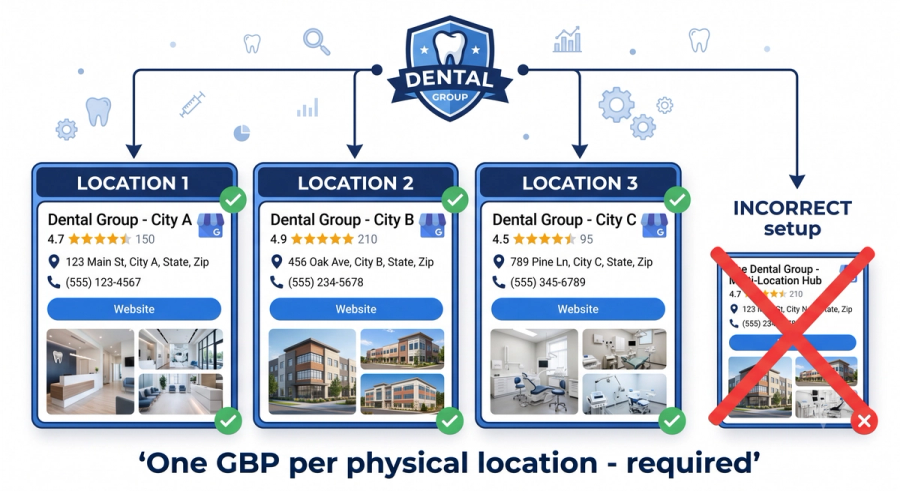
A single Google Business Profile cannot represent multiple practice locations. Google requires a separate verified GBP for each physical location. Each listing must have its own unique address, its own phone number, and its own set of reviews. Attempting to represent multiple locations from a single GBP listing will result in inconsistent local rankings and frequently in profile suppression.
Each GBP needs the same level of attention as a single-location practice would receive. This means complete service listings, location-specific business descriptions, regular photo updates, consistent review acquisition, and weekly posts. Managing multiple GBPs requires either a structured internal process or a specialist partner who can maintain all of them at the required standard.
Location Pages Are Not Optional
Every practice location needs a dedicated page on your website. Not a general about page that lists all locations. A fully developed page for each office that treats that location as its primary subject.
Each location page should include the full address and phone number of that specific office, the services available at that location, the practitioners who work there, local content referencing the neighbourhood and nearby landmarks, and a Google Maps embed for that location. It should be structured with the location name and city in the title tag and H1.
These pages are the on-site authority signals that support each GBP listing. A location page that is thin or that duplicates content from another location page is a liability, not an asset. Each page should be genuinely distinct.
Review Strategy Across Multiple Locations
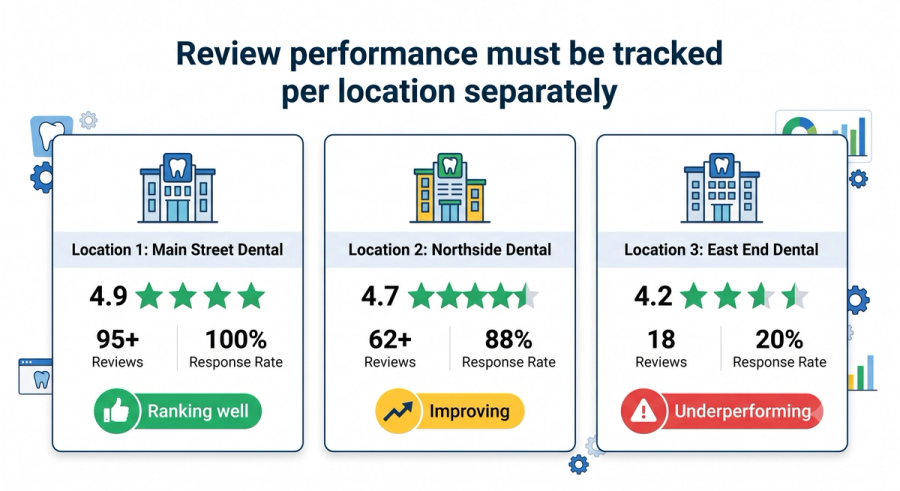
Reviews need to be acquired and maintained independently for each practice location. A group practice with one hundred reviews accumulated across two or three locations but siloed in a single GBP is in a weaker position than a competitor with forty reviews on a properly maintained single-location profile.
Each location needs its own review acquisition system. Staff at each office should be trained on the review request process. Automated follow-up tools should be configured separately for each location so that review requests reference the correct location name and direct patients to the correct GBP listing.
Monitoring response rates separately by location is also important. A group practice where one location responds to every review and another has a 20 percent response rate will see measurable differences in Map Pack performance between the two offices, even if all other factors are identical.
Avoiding Keyword Cannibalisation Across Locations
When multiple locations serve overlapping geographic areas, there is a risk of keyword cannibalisation, where two of your own pages compete against each other for the same search query. This weakens both pages and produces unpredictable rankings.
The solution is clear geographic differentiation in your keyword strategy. Each location page should target the specific city, neighbourhood, or suburb where that office is located. If two offices serve the same city, distinguish them by neighbourhood name, nearest major cross street, or adjacent suburb. The goal is to give Google a clear, unambiguous signal about which page is relevant for which geographic area.
Managing more than one dental location and not ranking consistently across all of them?
Get a free multi-location SEO audit from ClickWave
Frequently Asked Questions
Can I use the same content across multiple location pages?
No. Duplicate content across location pages is a direct ranking penalty. Each location page must be written as a unique piece of content focused on that specific office. Changing the city name and a few phrases while keeping the rest of the copy identical is not sufficient differentiation in Google's evaluation.
Should all my locations be on the same domain?
Yes, for most practice groups. Keeping all locations under a single domain builds shared domain authority that benefits every location page. Separate domains for each location split that authority and require each domain to be independently established.
What is the biggest multi-location SEO mistake dental practices make?
Using a single GBP for all locations or neglecting the GBP and review acquisition for newer locations while focusing all effort on the original practice. Every location needs equal SEO attention from the moment it opens.